

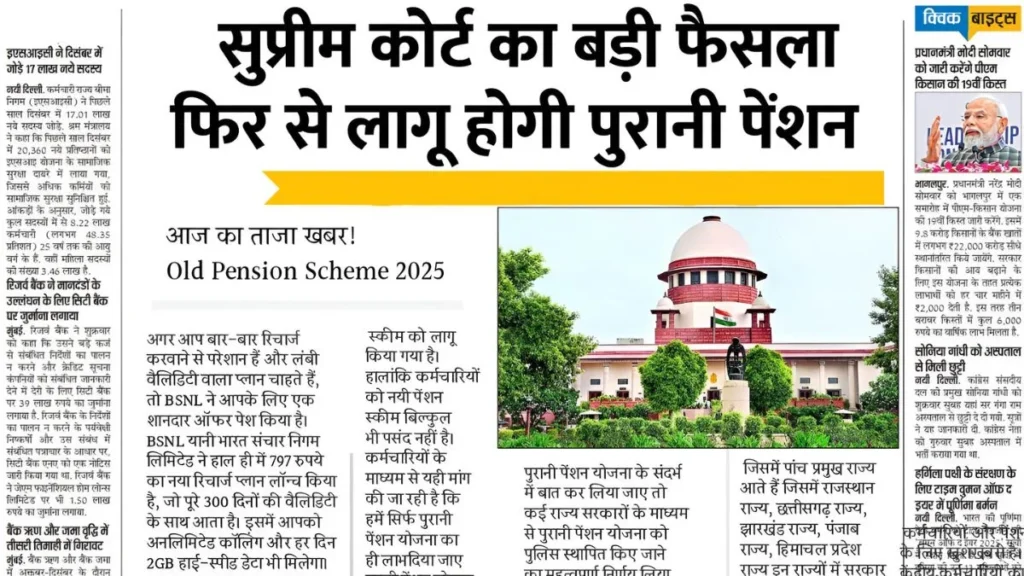
The Old Pension Scheme (OPS) continues to be one of the most debated topics among government employees in India. Every few weeks, social media posts claim that the Central Government has restored OPS or that the Supreme Court has passed a major verdict in favor of it. However, before believing such viral news, it’s crucial to verify it through official government sources, as misinformation can cause unnecessary confusion and disappointment.
Thank you for reading this post, don't forget to subscribe!This article explains the current status of OPS, how it differs from the New Pension Scheme (NPS), the stance of both central and state governments, and what employees should practically do to secure their retirement.
🔹 What Was the Old Pension Scheme (OPS)?
Before 2004, the Old Pension Scheme was applicable to central and most state government employees. Under this system:
- Retired employees received 50–60% of their last drawn basic salary as a lifetime pension.
- They were also entitled to Dearness Allowance (DA), which increased over time.
- After the pensioner’s death, their family received a family pension.
- Employees did not contribute toward their pension — all expenses were borne by the government.
🔹 Why Was the New Pension Scheme (NPS) Introduced?
In 2004, the Central Government introduced the New Pension Scheme (NPS) to reduce the growing financial burden of OPS.


Under NPS:
- Both the employee and government contribute a fixed percentage of salary to a pension fund.
- The money is invested in market-linked instruments, meaning returns depend on market performance.
- Employees get a lump sum and annuity (monthly pension) after retirement based on their accumulated fund value.
However, many employees have expressed concern over uncertainty in post-retirement income, leading to widespread demand for reinstating OPS.
🔹 The Central Government’s Official Stand
The Central Government has repeatedly clarified that it has no plans to restore the Old Pension Scheme, citing long-term fiscal challenges.

According to government officials:
- OPS places a heavy financial burden due to increasing life expectancy and growing pension liabilities.
- The government prefers to reform and strengthen NPS, introducing hybrid models with minimum guaranteed returns and improved benefits.
🔹 State Governments’ Different Approaches
Several states — including Rajasthan, Chhattisgarh, Himachal Pradesh, Punjab, and Jharkhand — have announced the reimplementation of OPS for their employees.
However, other states remain cautious, as OPS significantly increases long-term expenditure. The difference between central and state policies has created a divided pension landscape in India.

🔹 Beware of Social Media Rumors
Messages like “OPS implemented nationwide” or “Supreme Court orders OPS restoration” are false and misleading.
As of now:
- There is no official central government notification restoring OPS.
- The Supreme Court has not issued any universal order reinstating OPS.
Employees should always verify such claims through official portals like the Department of Personnel & Training (DoPT) or the Ministry of Finance before believing or sharing them.

🔹 Practical Advice for Employees
Here are a few steps government employees can take:
- Follow official sources – Always refer to DoPT or Finance Ministry websites for authentic updates.
- Understand your NPS – Learn about Tier-I & Tier-II accounts, fund allocation, and tax benefits.
- Plan for retirement smartly – Use instruments like EPF, PPF, SSY, or mutual funds alongside NPS for better financial security.
- Engage constructively – Raise suggestions legally through employee unions, focusing on better annuity rates or guaranteed returns.
- Check your state’s policy – For state employees, refer to your government’s official notification; for central employees, NPS remains mandatory.
🔹 Conclusion
The Old Pension Scheme (OPS) remains an emotionally and financially sensitive issue. While a few states have reinstated it, the Central Government continues to emphasize the reformed NPS model to balance fiscal responsibility with employee welfare.
Employees are advised to stay informed through official announcements, ignore unverified news, and plan their retirement wisely under the current NPS framework.

Disclaimer:
This article is for informational purposes only. Pension rules and policies are subject to change. Always refer to official government notifications or consult authorized departments for the latest updates and legal information.



1 thought on “Old Pension Scheme (OPS) 2026 – What Central & State Government Employees Should Know”